Venerean phases
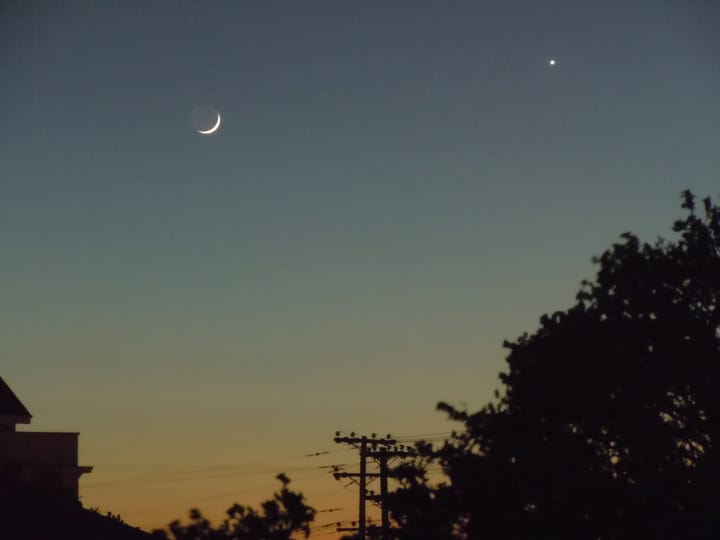
Venus has been very bright in the evening sky lately, as you may have already noticed. A friend of mine was playing with an astronomy program on his iPod Touch while we were walking the other evening and asked what «that bright star» was. I said that an object in the sky as bright as the one we were looking at could only be Venus (correct) and I speculated that Venus might be brighter when farther from us, because we’d be seeing more of the bright side (not correct. Sorry!)
Said speculation was wrong because I’d underestimated the change in apparent size of a planet that always looks like a point of light to the naked eye. Venus orbits at about seven-tenths as far from the Sun as we do. When Venus is at its closest to us it is about 0.3 Astronomical Units (one AU is the distance from the Earth to the Sun) which is very much closer than 1.7 AU so even in crescent phase the bright side of Venus takes up more space in the sky than when it is full on the other side of the Sun. (I’m not going to bother with the math for how far away Venus would be at various points on its orbit relative to us. «A lot closer» is good enough for me.) This appears to be true until the crescent gets very thin.
An Astronomy Photo of the Day from a couple of years ago illustrates this.
It seems that Venus is approaching as near to us as it ever gets. I’m assuming that for my purposes I can disregard the elliptical nature of Venus’ orbit because Wikipedia says that Venus’ orbit is much closer to circular than ours. Venus will transit the Sun in the beginning of June and we pass perihelion in the beginning of July, so I think it’s fair to say that Venus is pretty darn close now and will be nearly as close as it ever gets in June.
(I could do the math for this as well, but my math skills are so rusty that it might take all afternoon and I’m too lazy to do that right now.)
I took my binoculars out to look at Venus last night to see whether I could see a crescent shape. I thought that I glimpsed the crescent through my 12x binoculars, but owing to them being binoculars it’s difficult to get a perfectly sharp focus in both eyes at the same time. It’s also very difficult to find an adequate surface to use to keep the binoculars steady. Even propping my arm against the ground there was enough movement in my hands that I didn’t get as good a look at Venus as I’d like. It’s difficult to know whether my eyes actually resolved the crescent shape or if my mind filled in the blank from seeing motion «blur» from persistent vision or monochromatic aberration in the binoculars’s lens (or my eye, for that matter.)
It’s too bad that I don’t have enough magnification to see clearly the second-nearest object in our solar system. Living in the City means fighting to see through light pollution, and I don’t have anything stronger than the 12x binoculars. I’ve wondered at the possibility of getting a telescope, but it would have to be a pretty small one in order to be transportable with tripod on my motorcycle, and I’d need the motorcycle to get the ‘scope far enough away from the City that I’d get dark skies.