September 22 GOP debate wrapup
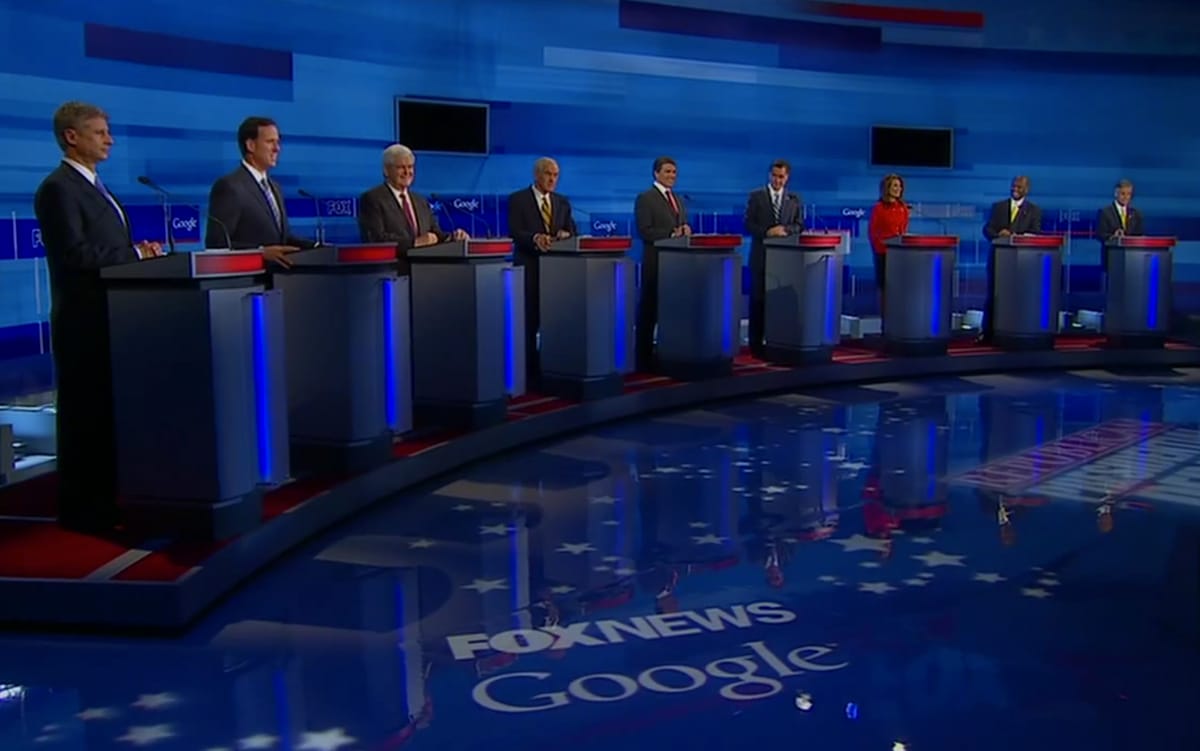
On Thursday, nine contenders for the GOP nomination for president participated in a televised question-and-answer session hosted by Fox News and Google. As usual, I hesitate to refer to these events as «debates» because they really aren’t debates. There’s not enough time allotted to permit more than a soundbite on each issue and there are few real chances for rebuttal. They are all about the personalities and very little about the principles and issues.
Here is my take on the candidates’ showing, in order of my general opinion of the candidate (not in order of how I thought they did Thursday evening, though there is a rough correlation) from best to worst.
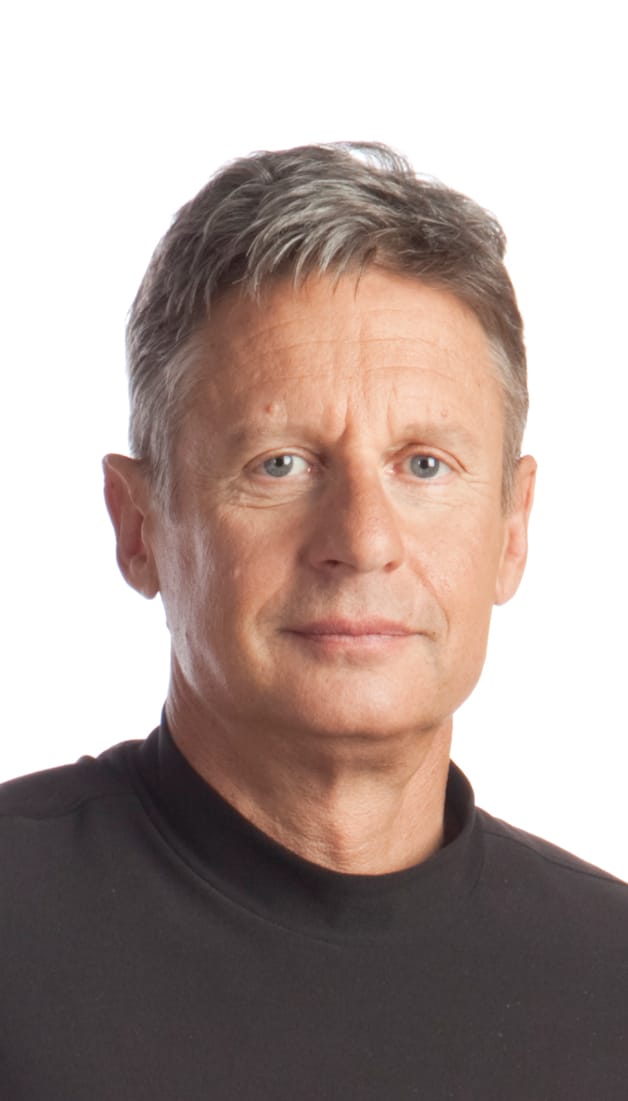
Gary Johnson
Governor Johnson didn’t get as much time to discuss substantive issues as the other candidates, but he compensated for that with his quip about his neighbor’s two dogs. That got him some of the attention he needs in the national spotlight.
I can’t help but think it was a mistake for him to hold his tongue when Stephen Hill was booed by members of the audience. There are two parts to Johnson’s appeal as a candidate. One is his fiscal restraint, but that doesn’t distinguish him from the rest of the candidates on the stage as much as the other: his fervent belief that the GOP should not be the party of intolerance. It was not Governor Johnson’s turn to speak, but someone should have delivered a reprimand to audience members who booed a soldier serving in Iraq. It was an embarrassment to the Republican Party and an embarrassment to all Americans.
Remaining silent at that moment should be an embarrassment to everyone who was on that stage, but Governor Johnson is the only one who has expressed his regret for staying silent except for Rick Santorum who actually had the floor and who claimed not to have heard the loud booing in the hall.
##Jon Huntsman Jr
Jon Huntsman may be so high on this list only because I know so little about him and his policies, but much of what I do know about him I like. He’s a motorcyclist—a lousy reason to vote for any candidate but I can’t help but give him a thumbs-up for riding on two wheels. He and his family give very generously to charities, which I find laudable in any candidate, but especially in a republican. Too often conservative rhetoric about charity being the job of the individual rather than the state rings hollow. It seems as though they’d really rather do nothing at all than help others. This is a myth, of course. Conservatives are generally more generous donors to charity, both in total numbers and as a percentage of their income. Nevertheless, it’s important to see the myth visibly subverted. Jon Huntsman is by all accounts one of the nicest people you’d want to meet. He comes across as fair-minded and honest, although I can’t say I approve of his positions on reproductive and civil rights.
##Ron Paul
Dr Paul has a vocal following and is thought of as the premier libertarian republican, and he should. Dr Paul was the Libertarian Party presidential candidate in 1988 before he joined the Republican Party. The guy has his economic theory down but he has a lot of trouble communicating the relationship between economic theory and economic policy he’d recommend. The problem may be only that he tries to communicate said relationship. Start talking about fiat currencies and boom-bust cycles and American eyes start to glaze over. It is great to see his ideas make it to the stage but Gary Johnson is more truly libertarian and has more practical, definable solutions to the issues that face America.
##Herman Cain
It’s disappointing to see Cain eschew the FairTax in favor of his 9/9/9 plan which, despite being better than our current system fails to address the fundamental flaws with the Internal Revenue Service. Beside that, I don’t see him bringing a lot of ideas to the table. At this point, Cain may be damned with the abundance of faint praise.
##Mitt Romney and Rick Perry
Mitt and Rick both lose points for sniping at one another constantly. Both of you, stick to the issues. The Punch and Judy show stopped being amusing long ago.
##Newt Gingrich
Newt didn’t say much new this time around, but as he continues to campaign he looks less and less presidential. There’s no question that Newt is smart, knowledgable, and experienced but he’s also looking tired and less like he actually wants the presidency than enjoys the attention he gets from participating in the debates. I can’t blame him; I think if I were in his shoes I’d attend any debate I was invited to and not drop out of the race unless I had some better job offer. Ultimately, Newt ought to stick to an academic role: teaching, writing policy papers, editorials, op-ed pieces, and acting in the occasional advisory role. That appears to be what he’s best at and he ought to stick to that once he’s done having fun on the debate stage.
##Rick Santorum
Rick Santorum has been my least favored candidate from the very beginning, and in Thursday’s debate he cemented his position as a person that should be prevented from holding public office. Rick Santorum and Michele Bachmann worked hard to make it to the bottom of this list, and Santorum’s answer to Stephen Hill’s question about Don’t Ask Don’t Tell constituted Santorum’s effort in the race to the bottom. Regardless of whether he heard the booing of Hill (or his question—the distinction is meaningless) his answer showed his own intolerance and lack of respect. Santorum failed to thank Hill for his service, which displayed tremendous disrespect in light of the fact that Santorum was saying he would return to a policy of discrimination against Hill in the military if elected president.
Regardless of how one feels about the policy of openly-gay individuals serving in the military, if being homosexual without committng any sexual acts is grounds for dishonorable discharge as it was until the repeal of Don’t Ask Don’t Tell, the «special treatment» is the discrimination against gays. Failing to discharge a soldier or an officer for being homosexual is not a «special privilege» as Santorum called it—it is the absence of a special privilege. In essence, Santorum told the soldier that he was receiving special treatment for continuing to be permitted to risk his life to keep Santorum and the rest of us safe and secure. That’s not just wrong, it’s ingrateful and unbecoming of anyone aspiring for public office on any level. The second half of his answer—that he would exempt military personnel who came out as homosexual after the repeal of DADT but before Santorum reinstates it—was what kept him from beating Bachmann for last place on the list. I also give him some credit for condemning the booing, even if he didn’t do it until the day after the debate.
##Michele Bachmann
Bachmann impressed me when I first heard her speak. She seemed sharp and on the ball, although I can’t say I loved her positions on many issues. The press made far too big a deal over her confusing Concord New Hampshire with Concord Massachussets—they’re only sixty miles apart. It was a mistake, but was it really any worse than Obama saying he’d be travelling to all fifty-seven states? When I see the press focus on something as trivial as a misstatement in public speaking it earns that person my sympathy.
However, since then, she has taken every possible chance to lower herself in my eyes. In the previous debate Bachmann tore into Rick Perry about the «forced» immunization of twelve-year-old girls in Texas on Perry’s watch. In so doing she came out strongly and passionately in favor of death by cervical cancer. Yes, she raises a valid public health policy question about the authority of the state to mandate immunization against infectious diseases, but by her logic we ought to bring back smallpox and polio and stop immunizing children against infectious diseases that they will then pass on to adults with less-robust immune systems.
It’s not her logic that is most upsetting. Rather, the most upsetting part of her argument is the utterly irrational assertion that there is something immoral about giving girls as early as nine years old a vaccine for a sexually-transmitted disease (Human Papillomavirus is the primary cause of cervical cancer) and that it somehow taints the girls’ innocence. What’s maddening about this is that the vaccine is only effective as a preventative measure. The idea is to get girls vaccinated before they become sexually active. It’s absurd to think that a shot in the arm at the doctor’s office is in some way morally corrosive. The only justification for this position is that cervical cancer is God’s punishment for the sin of sex—including marital sex—and that only by threatening our daughters with death can we keep them «pure». That sounds like Sharia law.
Bachmann was also asked about her implication that Gardisil causes brain damage and in typical politician form she refused to take responsibility for spreading misinformation. She said she never claimed that the vaccine caused brain damage, that she was only passing on information given to her by a woman who claimed her daughter had become developmentally disabled as a result of the vaccine. That Bachmann won’t even acknowledge that she gave the impression of an endorsement of patently false medical information means that we must parse her every word very so carefully that there is no point in listening—she simply cannot be trusted.
The list of offensive things Bachmann has said which angered me is too long to list here, but one more from Thursday’s debate merits mention. The idea that opening diplomatic relations and trade with Cuba would represent an existential threat to the United States is absurd. Cuba’s human rights record could stand to be improved (greatly) before they get Most Favored Nation status, but opposing charter flights? Supporting the embargo against Cuba in the 21st Century is evidence of a position arrived at through emotional and ideological posturing, not any considered or researched decisionmaking.
##The crowd
The big loser in the debates so far has been the audience in attendance. I can’t think of a better way to reinforce the idea that republicans are all hateful, intolerant, bigots than to show someone a tape of one of these debates. The crowds have been ill-mannered, disrespectful, and inflammatory. This is not what the Republican Party should stand for and not the kind of conduct it should allow in its events. From booing when Newt Gingrich was introduced to applauding at mention of executions of criminals, to cheering «yeah» when asked if an uninsured person needing medical care should be refused treatment, to booing Ron Paul for suggesting that not all Muslims should be blamed for 9/11, to the previously-mentioned booing of a US Soldier serving in Iraq, the audiences at these debates have included vocal factions that are being used to show that republicans are mean-spirited and cruel.
Republicans are fond of complaining about how the press portrays them, but if republicans can’t keep from displaying themselves in this way, what are people supposed to think? Gary Johnson said, «The booing that occurred last night at the event is not the Republican Party that I belong to,» but if more of the party leaders don’t step forward to reprimand these classless hecklers, then the party leadership has tacitly approved of the sentiments. That would not only be not be the Republican Party I belong to, it would be the Republican Party that deserves to lose every election.