Performance on Mac Pro RAID
It’s probably a bit late in the game to be reviewing the performance of a four year old product, but one more set of benchmark results in the world can’t hurt much, and may shed some light on more general questions about RAID performance in different configurations.
Testing was performed on an 8-core 2008 Mac Pro with the Apple Mac Pro RAID card and four 15,000RPM SAS drives. The drives were formatted in between tests and the tests were performed with no data on the drives, so these results are neither scientific nor are they real-world results. But since the tests were performed on empty drives, we at least know that application-specific factors were not part of the results.
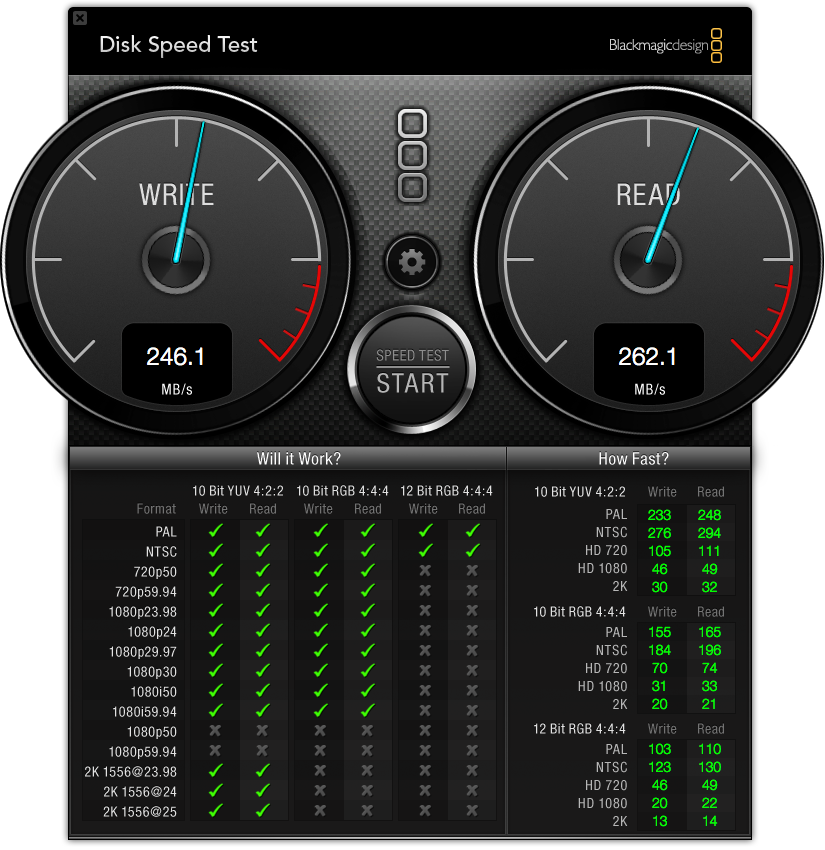
The tests were performed with BlackMagicDesign’s Disk Speed Test, which uses incompressible data to test the speed of transfers without the aid of compression algorithms that might artificially boost the performance numbers.
Though RAID 5 is often touted as a balance between safety and performance, a variety of sources around the Internet refer to the poor performance of RAID 5. One of the goals here was to determine how much of this is hyperbole and how much is truth.
Here are the raw numbers:
| JBOD, single drive | RAID 0, two drives | RAID 0, three drives | RAID 0, four drives | RAID 5, four drives | RAID 0+1, four drives | Single SSD | |
|---|---|---|---|---|---|---|---|
| write | 130MB/sec | 255MB/sec | 270MB/sec | 260MB/sec | 215MB/sec | 195MB/sec | 245MB/sec |
| read | 120MB/sec | 245MB/sec | 285MB/sec | 290MB/sec | 195MB/sec | 250MB/sec | 260MB/sec |
The SSD speed test is not from the same system and is included only as a reference.
These results suggest that RAID 5’s reputation for poor performance is somewhat deserved—RAID 0 with only two drives beats it by a significant margin—but RAID 5 is still much faster than JBOD. A four-drive RAID 0 is the fastest, but only by a very small margin over a three-drive RAID 0. (In this test the write performance was actually slower with four drives than with three, but even though the tests were verified multiple times the difference seems slight enough to consider this result a fluke.)
Surprisingly, RAID 0+1’s write performance was slower than any of the configurations. While RAID 0+1’s read performance is respectable the write performance is the slowest of all the tested configurations but JBOD. Of course, RAID 5 and RAID 0+1 offer reliability that RAID 0 does not, but except for high-availability systems for which downtime is not an option, it seems that RAID 0 plus a good backup and a spare drive or two on hand would be an obvious choice due to the performance benefit.
Again, these numbers may be very different with a different RAID controller or with a software RAID, and not just faster or slower. Different controllers may have totally different profiles or be optimized for particular configurations over others.
No configuration comes close to the 553MB/sec Apple claims you can get from their hardware RAID card. It shouldn’t be a surprise to see real-world benchmarks fall short of a manufacturer’s claims, but it really would be nice to see estimates in the same ballpark as the best results that might actually happen.